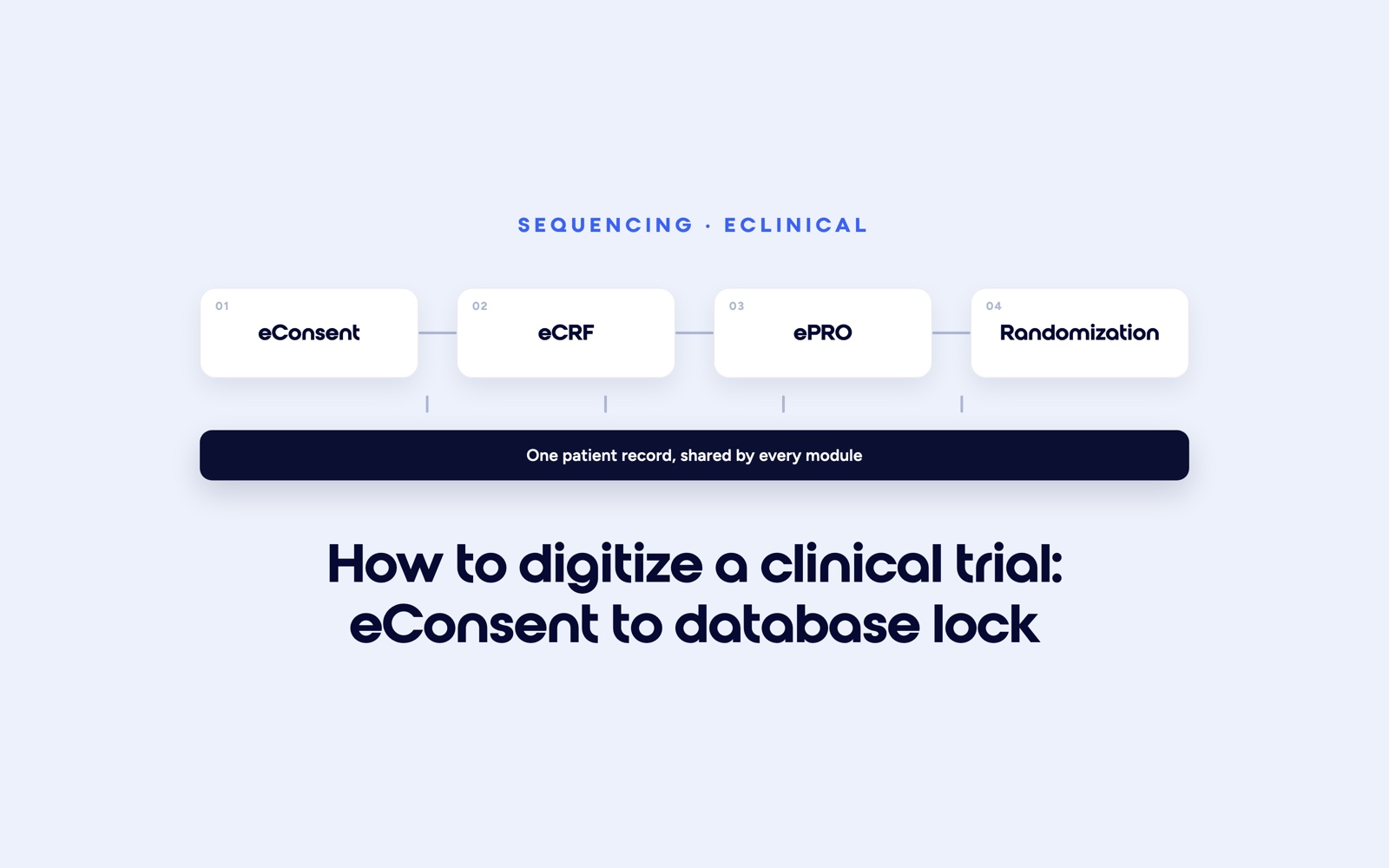
Digitizing a clinical trial end to end means chaining eConsent, EDC and ePRO so that each module works directly from the data the previous one validated: patient identity, eligibility, visit schedule.
Digitization rarely fails on the technology. It fails on sequencing: deploying the eCRF, configuring eConsent on a third-party tool months later, then bolting on ePRO last produces a siloed architecture. A full digitization sets out to remove that fragmentation.
The structural problem with a module-by-module approach
Building an eClinical architecture from disconnected modules produces systematic operational gaps. Using siloed tools imposes:
- Double entry: the coordinator records the patient's identity in the eConsent tool, then has to recreate it by hand in the EDC.
- Constant exports: ePRO data is exported from a third-party portal into a spreadsheet, then re-imported into the eCRF at every visit.
- Desynchronization risk: every manual transfer multiplies the chance of missed queries, or of versions that disagree between the site and the database.
The technical sequence holds in four implementation steps.
[[cta]]
Step 1: set up eConsent as the starting point
As the first digital point of contact, eConsent fixes the patient's identity and eligibility for the whole study.
Setting it up as a standalone signature tool produces a dead document. Beyond the implementation and compliance questions covered in Datacapt's eConsent guide, the technical stake is the data flow: consent status has to reach the EDC automatically. If the modules do not share that status, an ePRO app will keep sending completion reminders to a patient who has withdrawn consent.
Step 2: build the eCRF to absorb amendments
The eCRF (see its definition and how it differs from the paper CRF it replaces) acts as the central database for every other module. eCRF configuration time drives the whole calendar: a setup that stretches over three months blocks the deployment of ePRO and randomization.
In production, protocols change. The Tufts CSDD reference study (950 protocols) shows that 76% go through at least one amendment, against 57% in 2015. Digitization is effective when the team stays autonomous: they have to be able to change a form and republish it the same day. Waiting for the vendor freezes ePRO and randomization. The method for assessing that autonomy is set out in how to choose an EDC.
Step 3: bring ePRO into the central record
ePRO is frequently deployed through a separate app (BYOD), forcing the data manager to pull the data from an external portal to merge it into the eCRF.
Best practice is to configure ePRO as a native extension of the patient record. This approach removes all reconciliation: the data manager reads site entries and patient-reported data on a single timeline, with no export step.
Step 4: run randomization and monitoring
Once eConsent, the eCRF and ePRO are in sync, randomization and query management run on one consolidated database. During monitoring, a CRA reads consent status, eCRF history and ePRO results on a single screen. This technical centralization reduces the cost of collecting data and the risk of error at every visit.
Sequencing depending on where your study stands
- For a new study: the eConsent, eCRF, ePRO, randomization then monitoring order lets each module build on the data of the one before.
- For a study already running: adding a module has to happen without data migration. Connecting an ePRO module to a live eCRF is configuration work. Replacing the EDC mid-trial is a separate project that calls for its own assessment.
Using a unified clinical platform settles the sequencing question at the source: eConsent, EDC, ePRO and randomization share one database, removing the export flows. Zurko Research runs more than 300 studies a year on that model, with setup time cut by 45% thanks to the removal of the technical middlemen.
[[cta]]
Frequently asked questions
[[faq]]
What does digitizing a clinical trial end to end mean?
It means configuring every module, consent, data entry, patient outcomes, randomization and monitoring, to write into a single patient record, replacing the separate tools that force manual reconciliation.
Which module do you digitize first: eConsent, EDC or ePRO?
For a new study, eConsent goes first to fix identity and eligibility. For a study already running on paper, digitize the EDC first, stabilize it, then connect ePRO to it.
Can you digitize one module without replacing your whole software stack?
Yes, if the new component connects to the existing record, for example adding ePRO to a live eCRF. Replacing the main EDC mid-study calls for its own project management and a migration.
How long does digitizing a clinical trial take, from consent to database lock?
With a no-code build, a single-site study can start within days of mapping the protocol. A multi-site study covering eConsent, EDC and ePRO takes several weeks, most of it spent configuring the eCRF.
What happens to a study already running when you add a digital module?
On a unified platform, the record takes in a new data source without anything moving. On a third-party system, it calls for a one-off migration and a reconciliation process.


Florentin combines clinical research know-how with a true passion for product design. Attentive to detail and obsessed with user experience, he ensures that Datacapt remains a high-performance platform that’s also intuitive and accessible to every user.
Blog & News Datacapt
News, Articles, Resources et Tutorials.