Artificial intelligence for clinical trials, inside the EDC
Datacapt AI builds the study, reviews data as it arrives, and watches your sites. It runs on your permissions, writes to your audit trail, and stops at the line you set. Bring your own model over MCP, or use ours.
Run our agent, or connect your own model
Datacapt exposes its EDC through a Model Context Protocol server. Use the assistant that ships with the platform, or point Claude, ChatGPT, Gemini, Grok or a model you host yourself at the same server. Same permissions, same audit trail.
Datacapt AI, inside the platform
Ask in the chat that sits next to your studies. Nothing to install, no key to manage, no vendor account to open.
Your model, over MCP
Bring the client and the model your organisation already approved. The protocol is an open standard, so nothing ties you to our choice of vendor.
Three points in a study where the time actually goes
Protocol interpretation, eCRF design, data review, monitoring, audits, multilingual execution. A study leaks time at every one of them. These are the three where an agent gives the most of it back.
Build the study from the schedule of assessments
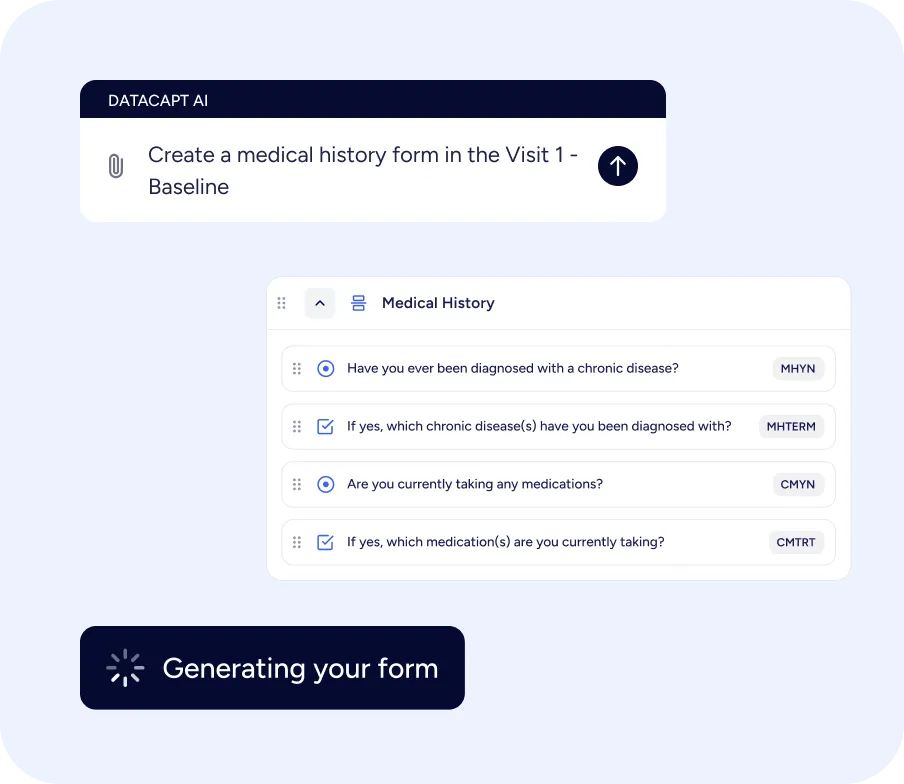
Going from a protocol to a working eCRF takes weeks. The thinking is quick. What eats the time is the entry: visits, forms, fields, edit checks, display conditions, then the test scripts.
Review what changed, not every field again
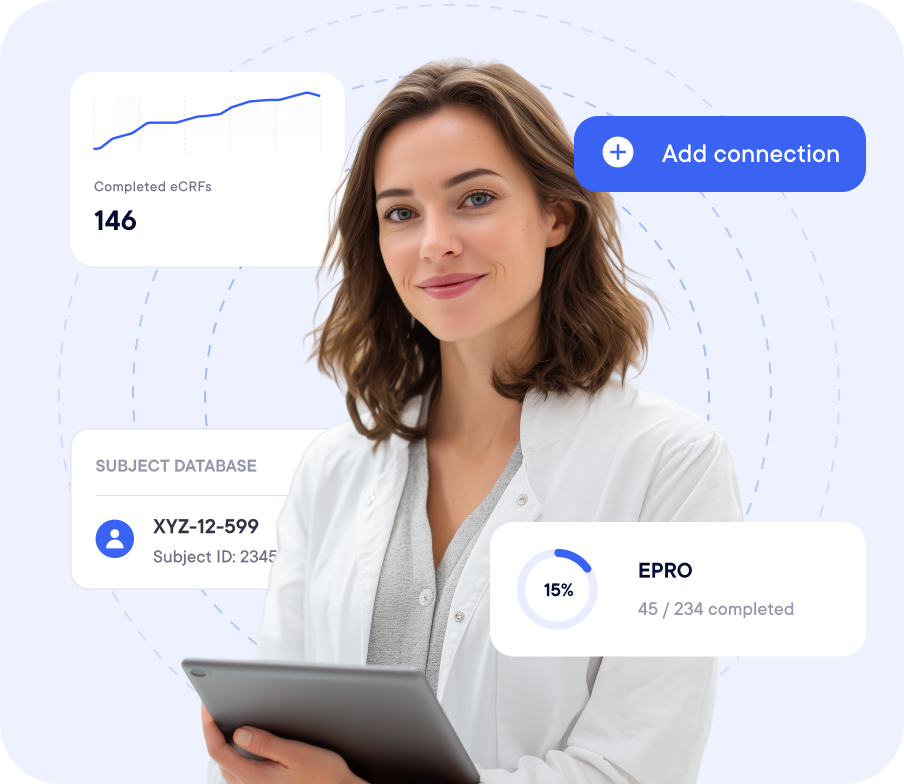
Manual review does not scale with a modern trial. Datacapt AI reads data as it arrives and puts what deserves your attention at the top of the queue.
Point your CRAs at the sites that need them
Datacapt AI reads site and study level signals as they move, so risk-based monitoring runs on what the data says this week rather than on the plan written last quarter.
Say what you need. The agent does the entry.
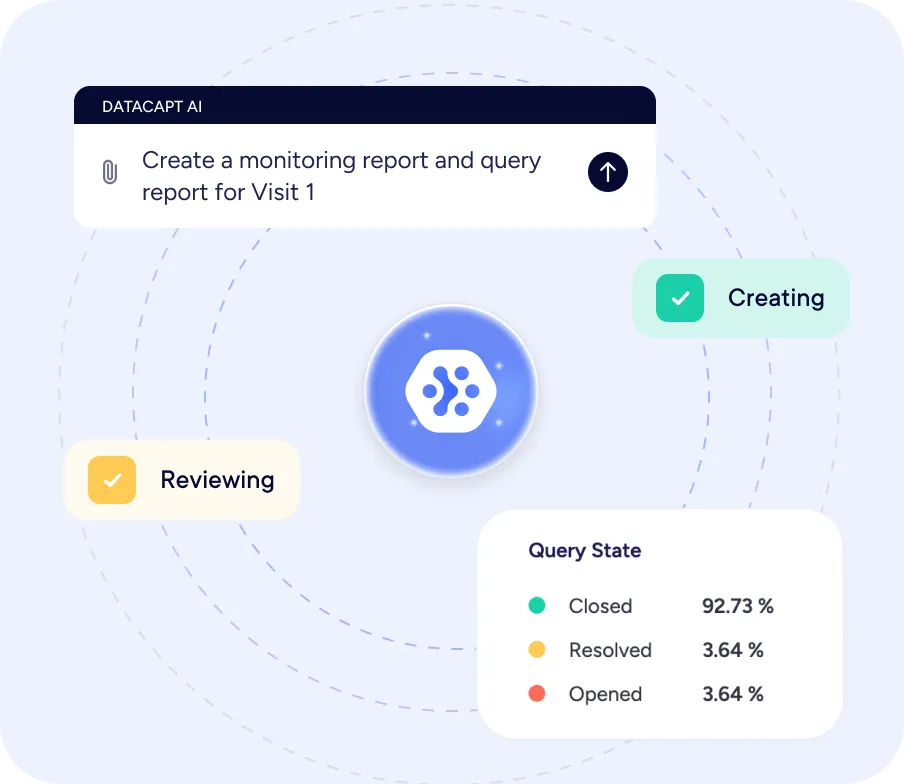
An MCP server publishes the EDC's capabilities as tools an agent can discover and call. Your data manager states the request in plain language, the agent picks the tools and reports what it wrote, and a person signs off before anything reaches production.
Six requests, no integration to build
Each of these is one sentence in a chat window. Behind it, the agent picks from the tools the MCP server exposes, calls them in order, and reports what it did. Adding a seventh request costs you a sentence, not a development cycle.
The model never sees your clinical data
Sending health data to a public model is a risk most sponsors and CROs will not take. We could do it with contracts, encryption and certified hosting. We send none of it instead, and everything else follows from that one decision.
Writes land in DRAFT
The agent writes to a draft study or a new version. Editing a published form, applying a code or touching collected data is not exposed at all. The check sits in the backend.
One key per user
The MCP key is separate from the API key: individual, time-limited, revocable in one click, with scopes and quotas fixed at creation. No organisation key, no service account.
MCP origin in the audit trail
Every call is logged with its tool, its parameters, the timestamp and the person who asked. An auditor isolates the whole set with one filter. The recorded actor is always a person.
A person accepts production
The agent prepares. Your data manager reviews the configuration, fixes what needs fixing, validates the tests, and signs the move to LIVE under their own name.
Datacapt AI is a set of artificial intelligence capabilities natively embedded in the Datacapt eClinical platform. It supports key clinical trial activities such as study design, data review, monitoring, query management, audit trail review, and translation. Datacapt AI assists users by identifying patterns, suggesting actions, and improving efficiency while keeping full human control and regulatory traceability.
Yes. Datacapt AI operates within the validated Datacapt environment and follows strict principles of traceability, transparency, and user control. All actions are logged, auditable, and aligned with clinical research compliance frameworks. AI outputs are explainable and can be reviewed at any time.
No. Datacapt AI is designed to support clinical teams, not replace them. All AI generated suggestions, queries, and insights require human review and validation. Decision making, approvals, and accountability always remain with qualified clinical professionals, in line with regulatory expectations.
Yes. Datacapt AI supports international studies by enabling instant translation of eCRFs, ePROs, queries, and study content. This helps ensure consistent terminology, faster communication with sites, and smoother execution across multiple countries and languages, while still allowing human review when required.
Datacapt AI assists with eCRF design by suggesting form structures, fields, edit checks, and validations based on protocol content and therapeutic context. This helps reduce study build time, improve consistency.
No. Datacapt AI does not generate or alter clinical data. It analyzes existing data and workflows to provide suggestions, alerts, and insights. All data entry, changes, and approvals remain under full human control and are captured in the audit trail, in accordance with clinical regulations.
Datacapt AI is purpose-built for clinical trials and embedded directly into the Datacapt eClinical platform. Unlike generic AI tools, it is designed around clinical workflows, regulatory constraints, and data integrity requirements, ensuring that AI delivers operational value without compromising compliance or control.
The Model Context Protocol is an open standard that describes how a large language model discovers and calls the functions of a third-party application. The Datacapt MCP server publishes the EDC's capabilities as tools an agent can call, so a data manager states a request in plain language instead of waiting for a connector to be built for it. The REST API still does the work underneath. MCP adds the layer that lets a model use it without a developer writing an integration for every scenario.
Yes. You can drive Datacapt from the chat built into the platform, or from the MCP client of your choice connected to the model your organisation approved: Claude, ChatGPT, Gemini, Grok or a model you host locally. The protocol does not depend on the model. Both routes go through the same MCP server, with the same scopes and the same audit trail, so a local model gets no more access than the built-in one.
No. The model receives counts, statuses, percentages and structures: enrolment per site, the SDV rate, the breakdown of queries by age, the sections of a form with their validation rules. It never receives a value entered in an eCRF, an ePRO response, a subject or screening identifier, consent content or a randomisation element. Monitoring endpoints that return enrolment-level rows are aggregated by the server first, so a raw row never leaves the platform. The single exception is a verbatim term sent on its own for a coding suggestion, with no subject, site, date or visit attached.
No. Writes are confined to studies in DRAFT or to a new study version, and that check sits in the backend rather than in the instructions given to the model. Editing a published form, applying a code or writing to collected data is not exposed as a tool at all. Moving to production requires explicit acceptance from a user, recorded in the audit trail under their name. Once a study is LIVE, any change goes through a new version, which returns to draft, and the agent with it.
Blog & News Datacapt
News, Articles, Resources et Tutorials.