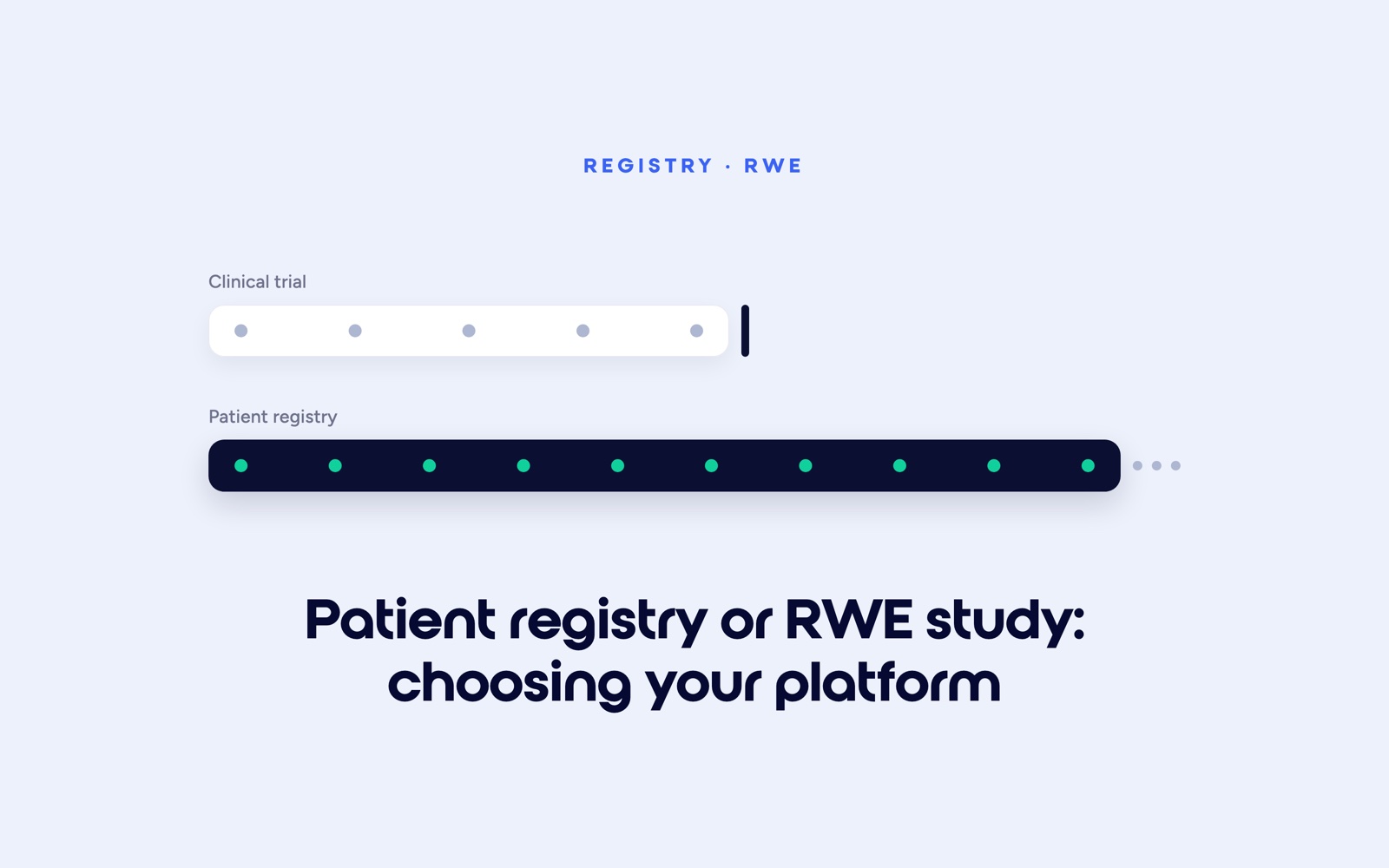
A patient registry or an RWE study needs a platform built for years of follow-up and data arriving from several sources, not a system sized for a fixed number of trial visits. Vendors in this market split along one line: TriNetX, Flatiron and IQVIA work from retrospective data already sitting in health records and claims databases, while Castor and Datacapt collect new data, from sites and from patients. Your side depends on one question: does your evidence already exist in someone else's database, or do you have to go and collect it?
Most registries and RWE studies start from an EDC scorecard written for interventional trials, then hit the mismatch once collection starts. A trial stops at database lock. A registry keeps collecting, sometimes for ten years, and the platform has to hold up for that long.
Why a registry or an RWE study is not a longer trial
A device manufacturer running a PMCF registry under EU MDR 2017/745 follows patients across several sites for years, and the follow-up calendar bends to each site's schedule rather than to a fixed visit window. A pharma team running a post-approval safety study pulls in claims and pharmacy data that arrive in a format the platform never saw during the pivotal trial. An academic registry following a rare disease cohort adds a new site every year, each with its own consent path and its own data flow.
None of these follows a fixed visit calendar, and none stops at a single lock date. The platform has to absorb new sites, new variables and new formats without a rebuild each time, because a rebuild means re-consenting or re-migrating a cohort that took years to enroll.
[[cta]]
Which platforms serve registries and RWE studies
| Criterion | Datacapt | Castor | Data networks (TriNetX; Flatiron, oncology only) | REDCap |
| Collection mode | Prospective, sites and patients | Prospective, sites and patients | Retrospective, health data already collected (records, clinical notes, genomics) | Prospective, site-entered |
| ePRO in the patient record | Yes, EDC, ePRO and eConsent on one connected record | Yes, native eCOA and patient app | Not applicable, the data is already collected | Native patient surveys, in the same project |
| PMCF and PMS under EU MDR | Yes, documented use case | Yes, PMCF templates and notified body reporting | No | No documented PMCF template |
| Pricing model | Annual subscription per study | Not published | Data license | Free for non-profit consortium institutions, self-hosted, no vendor support |
| Core market | Teams that run their own registry | Late-phase pharma and medical device | Pharma, healthcare providers and academic research | Academic research |
Step 1: start from the regulatory driver, not the feature list
A registry answers one of three regulatory objectives, and each one sets a different reporting rhythm. A medical device PMCF or PMS program under EU MDR 2017/745 Annex XIV Part B runs as a continuous process for as long as the device stays on the market, feeding the PMCF evaluation report and the PSUR or PMS report on a fixed schedule. A pharma post-approval safety study answers a specific regulatory commitment, often tied to a conditional authorization. An academic or epidemiological registry answers a research question with no external reporting deadline.
The FDA Real-World Evidence framework, published in 2018 in response to the 21st Century Cures Act of 2016, lists product and disease registries among real-world data sources, and covers their use to support a new indication or satisfy a post-approval study requirement. That framework applies to drugs and biologics; on the device side, CDRH carries its own guidance. This review starts with the platform: can it produce a clean, traceable export that a regulator can audit years after entry.
Step 2: test how the platform handles a moving target
Ask each vendor what happens to data already collected when the protocol changes, rather than watching a standard demo. A manufacturer's PMCF registry, launched with a single follow-up questionnaire, often needs a second one by year three, when a notified body asks for one more safety signal. The question that matters is about records already entered: do they stay readable and analyzable in one dataset, or does the registry end up with two datasets that a data manager reconciles by hand at every reporting cycle.
The same logic applies to protocol changes on a standard trial. A Tufts CSDD study of 950 protocols shows that 76% go through at least one amendment, against 57% in 2015. A registry that runs for years faces this more, not less. We run the same test in how to choose an EDC, a method that applies to a registry too.
Step 3: check multi-source and patient collection over several years
A registry or RWE study rarely collects from one source. Site teams enter clinical observations, patients report outcomes through an ePRO questionnaire sent every quarter for years, and a claims feed or a lab export increasingly joins the two. Ask whether the platform captures ePRO data in the same patient record, or in a separate export that a data manager reconciles by hand at every reporting cycle.
A registry following a chronic condition over five years depends on that ePRO channel to keep working without re-enrolling participants every time someone changes phone or app.
Step 4: assess the vendor over the long run, not the pilot
A registry that runs for ten years outlives most vendor contracts. Ask what happens to the data if you move platform after three years: can you export a complete, structured history, or does the registry restart with only part of what was collected. Check the pricing model too: a per-study price sized for a two-year trial does not fit a program with no defined end date, while an annual subscription protects the budget better over time.
Ask for a reference on a long-running registry or RWE study specifically, not on a short interventional trial. Both fall in the same software category, but the operational requirements rarely overlap.
Which criteria matter for your registry
Medical device PMCF or PMS registries (EU MDR). The continuous reporting cycle to the notified body drives the platform. Prioritize a system that produces an audit-ready export on demand and absorbs a new follow-up questionnaire without a rebuild, over the one with the longest feature list.
Pharma post-approval safety studies. The regulatory commitment behind the study sets a strict reporting deadline. Prioritize traceability and a clean audit trail across every data source over initial setup speed.
Academic and epidemiological registries. Budget and headcount decide, often with no dedicated data manager. Prioritize a no-code build your team can run alone, and a pricing model that survives a study with no fixed end date.
When Datacapt is not the right choice
Your evidence already sits in health records or claims data. If the study answers its question from retrospective data on millions of patients, a data network such as TriNetX or Flatiron reaches that population. A prospective collection platform does not.
You need someone to run the study for you. A program where the sponsor delegates conduct end to end calls for a CRO or a full-service provider, not a platform your team runs itself.
What Datacapt brings to a registry
A connected patient record holds clinical data, ePRO and eConsent together: the questionnaire sent to the patient each quarter lands in the same record as the site's observations, instead of a separate export the data manager reconciles at every reporting cycle. eConsent halves the consent cycle, which counts on a cohort you re-consent at every protocol change. Zurko Research runs 300 studies a year on the platform and cut its setup time by 45%. Pricing works per study on an annual subscription: a registry with no end date does not pay a price calibrated on a two-year trial.
No platform wins on every criterion for every type of registry. The right system is the one still serving the study, and the team running it, five years after the first patient enrolled.
[[cta]]
Frequently asked questions
[[faq]]
Which platforms are built for patient registries and RWE studies?
Castor and Datacapt collect registry data prospectively, from sites and from patients, with ePRO and eConsent inside the platform. TriNetX, Flatiron and IQVIA work from health records and claims data already collected. REDCap covers academic registries with no commercial support. The choice follows one question: do you have to collect the evidence, or does it already exist?
What separates a patient registry or RWE study from a clinical trial EDC?
A registry collects data over several years rather than over a fixed number of visits, from more than one source, and with no single lock date. The platform has to absorb new sites, cohorts and formats without a rebuild each time, which a system sized for a two-year interventional trial rarely handles well.
Which features matter most for a PMCF registry under EU MDR?
The ability to add a new follow-up questionnaire or a safety variable without migrating existing patient records, and to produce a clean, audit-ready export on demand for the PMCF evaluation report or the PSUR. EU MDR 2017/745 Annex XIV Part B treats PMCF as a continuous process throughout the life of the device.
Can you add new variables or cohorts to a registry after collection starts?
On most modern platforms, yes, as a configuration change rather than a rebuild, provided the platform stores data on a connected record rather than on a frozen form template. Ask each vendor to demonstrate it on part of your real protocol.
How long does a patient registry or RWE study collect data?
It depends on the regulatory driver. A medical device PMCF registry runs for as long as the device stays on the market. A post-approval safety study runs for the duration of the regulatory commitment behind it. An academic registry often has no fixed end date.
What happens if you have to change platform mid-registry?
It depends on how the old platform exports data. A complete, structured export lets a new platform pick up the cohort without a break. A partial export, common in systems that were not designed for long-term data ownership, can lose years of context on the participants being followed.


With over 10 years of experience working in CROs, Khalil brings deep expertise in clinical trials and a clear understanding of the daily challenges faced by research professionals. His insights are grounded in real-world operations, making his perspective both practical and strategic.
Blog & News Datacapt
News, Articles, Resources et Tutorials.