- Datacapt hosts the platform, provides the validation package and brings data collection (EDC, ePRO, eConsent, randomization, medical coding, trial supply management) and site operations (Site CTMS: patient database, patient recruitment, calendar & scheduling, patient compensations) together in one patient record, with reduced pricing for academic teams.
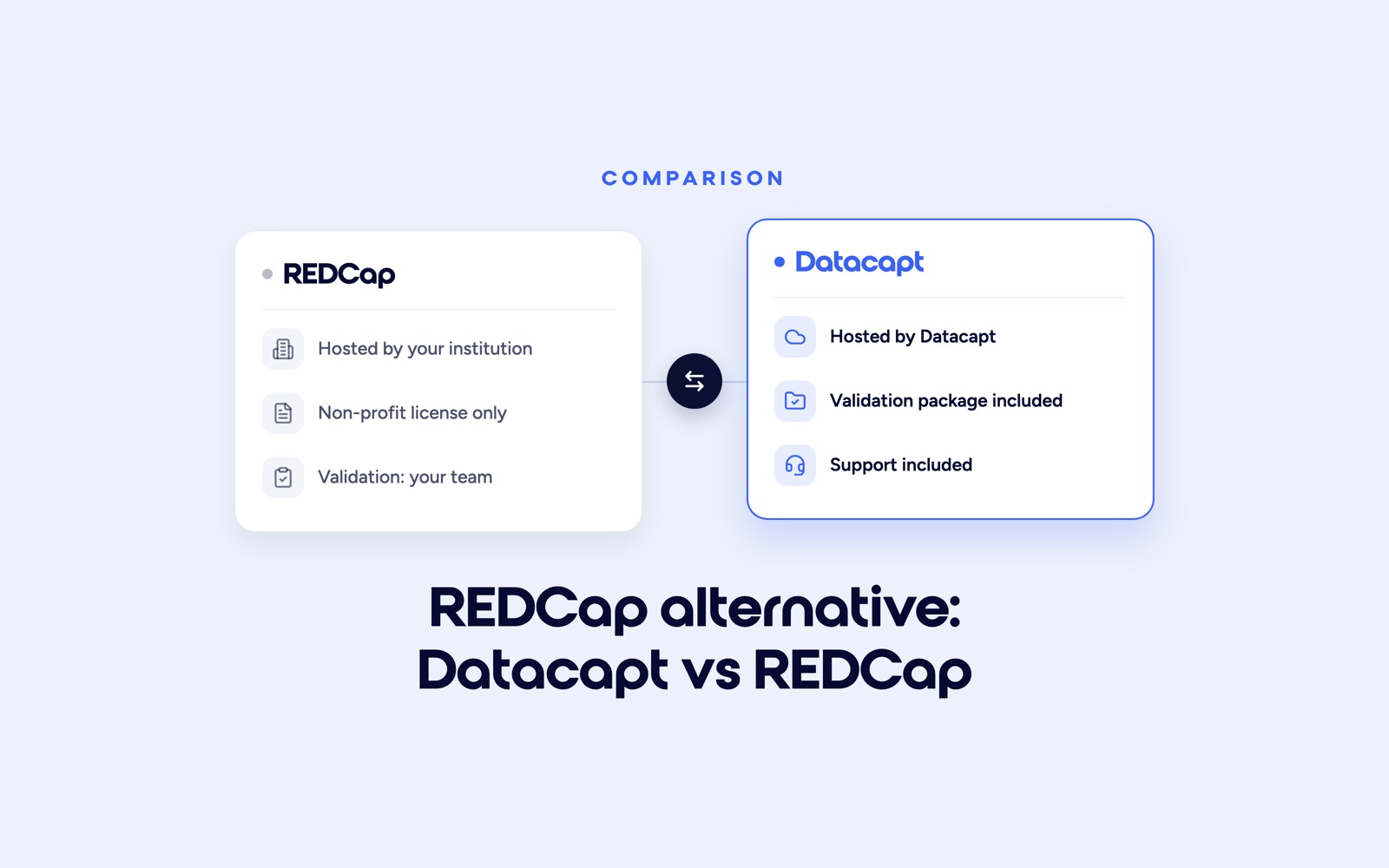
- Datacapt and REDCap differ in which organization hosts the tool, which one documents its validation and which one supports your users.
- The REDCap license is reserved for nonprofit organizations: a company can neither hold the license nor host the tool (projectredcap.org, 2026).
- The sponsor remains responsible for validating a system, whether it is free, commercial or provided as a service (EMA, 2023).
- Switch tools between studies when you can: an ongoing study can also migrate, provided you validate the migration (EMA, 2023).
The right REDCap alternative depends on what your institution wants to keep handling itself: hosting, validation and user support. Datacapt is designed for hospital and university research teams, CROs and sponsors that want an EDC hosted and maintained by the vendor and delivered with its validation package. Datacapt brings data collection (EDC, ePRO, eConsent, randomization, medical coding, trial supply management) and site operations (Site CTMS) together in one patient record and offers reduced pricing to academic teams.
This page compares Datacapt and REDCap side by side, then details the criteria to compare and the steps to migrate a study.
Why do teams look for a REDCap alternative?
Teams look for a REDCap alternative when their institution no longer wants to carry the hosting, maintenance and support of the tool on its own, when a company joins the study as sponsor or when an inspection is coming up. They want an EDC that the vendor hosts and maintains, a validation package delivered with the platform, and ePRO, eConsent and randomization in the same patient record as the EDC.
REDCap has no license cost for nonprofit organizations that are members of the consortium. According to the project's official website, accessed on November 10, 2026, the institution's in-house IT team installs, maintains and supports the system; the license prohibits handing this work to a contractor. The REDCap team at Vanderbilt suggests dedicating 0.25 full-time equivalent (FTE) to administering it during the first two months, then 0.1 FTE. It also recommends 0.5 FTE of user support.
This workload grows with the study: each new site adds users to support, and an inspection examines the environment your IT team has built. If a company sponsors the study, it cannot obtain a REDCap license.
Datacapt vs REDCap: what are the differences?
Datacapt and REDCap both collect study data with an audit trail and multisite access. They differ in which organization hosts and maintains the system, which one documents its validation and which one supports its users. The table reflects what the official REDCap website and Datacapt's pages published as of November 10, 2026.
| Criterion | Datacapt | REDCap |
|---|---|---|
| Who can obtain the tool | CROs, industry sponsors and academic teams, with reduced pricing for universities, hospital research teams, charities and foundations | Nonprofit organizations that are members of the consortium. A company cannot obtain a license. |
| Who hosts and maintains it | Datacapt, on 3DS Outscale (SecNumCloud-qualified by ANSSI, HDS-certified) or in AWS regions, with nothing to install on your side | Your institution, on its own servers or its own cloud, with its own IT team. The license excludes IT contractors. |
| Who documents validation | A validation package included in the price, which the sponsor assesses for its own use | Your institution, which builds the environment and documents its compliance |
| Who supports users | Support, training and a Customer Success Manager included in the price | Your institution's REDCap team. The Vanderbilt team does not handle questions about other installations. |
| ePRO, eConsent, randomization | In the same patient record as the EDC, with role-based masking and emergency unblinding | Online surveys, the MyCap app for participants and electronic consent. The modules enabled and validated depend on your installation: ask your REDCap team whether randomization is enabled. |
| Time before launching a study | No installation. Study go-live in 1 to 4 weeks depending on protocol complexity | If your institution already has REDCap, its team creates your account. Otherwise, allow about a month of license processing before your IT team starts the installation. |
| What you pay | A quote per study or an annual license, unlimited users, no setup fees | No license cost. Internal time: Vanderbilt suggests 0.25 FTE of administration at launch, then 0.1 FTE, and recommends 0.5 FTE of user support. |
For a team without an IT specialist dedicated to research, the gap lies in hosting and support. On validation, Datacapt provides a package that the sponsor assesses; with REDCap, the institution produces this package itself. Our article on choosing an EDC for an academic clinical trial details the criteria specific to academic research, and our EDC platform comparison ranks thirteen platforms by study type.
What does Datacapt offer as a REDCap alternative?
With Datacapt, your research team has no server to install or maintain, receives a validation package with the platform and works with every other module in the same patient record as the EDC: ePRO, eConsent, randomization, medical coding, trial supply management and Site CTMS.
- Nothing to install. The platform requires neither installation nor a dedicated IT team, as our page for academic research teams states. You choose the hosting: 3DS Outscale, a French cloud that is SecNumCloud-qualified by ANSSI and HDS-certified, or AWS regions, as the security page specifies.
- Validation package, support and training included, with a Customer Success Manager, unlimited users across all sites, no setup fees and reduced pricing for universities, hospital teams, charities and foundations, as the pricing page details.
- One patient record for EDC, ePRO, electronic consent, randomization, medical coding and trial supply management, as well as for the Site CTMS modules used at the site: patient database, patient recruitment, calendar & scheduling and patient compensations. Datacapt's randomization module handles block, stratified, dynamic and minimization schemes, masks the treatment arm according to each user's role and restricts emergency unblinding to authorized roles.
- A study built by your team in 4 days, with a first patient enrolled in the first week, according to Datacapt's EDC product page. Your team modifies forms during the study, without redeployment or data loss.
- CSV, XLSX, PDF and SAS exports for your statistician.
At CHRU de Strasbourg, a medical team ran a real-world survey on sleep with 24 questionnaires per patient, sent by the platform according to the study calendar. Users worked independently after one to two hours of training. Patients completed 85% of the questionnaires themselves on the platform.
[[cta]]
What should you compare when choosing a REDCap alternative?
Compare platforms on your next study. Four questions set the options apart: who supports the users at your sites, who can use the tool when the sponsor is a company, who documents validation and which modules share the patient record.
Who supports the users at your sites
REDCap lets researchers from several sites and several institutions work in the same database. The institution that hosts an installation maintains it and supports its users: in a multicenter study, the teams at the other sites therefore turn to your team for their accounts, access rights and questions. When the sponsor of an investigator-initiated trial hosts the data itself, the EMA's 2023 guideline on computerized systems asks the sponsor to justify the host's independence and to document it in the agreements (section 6.6). The guideline gives the example of a central IT department that does not take part in the trial and provides investigators with a copy of their data. Ask each vendor who handles questions from site users and what its support covers.
Who can use the tool when the sponsor is a company
A REDCap license is granted only to nonprofit organizations with sufficient IT infrastructure to host the tool. A company, whether a manufacturer or a CRO, can neither hold the license nor host REDCap. Ask each vendor whether a sponsoring company can use the tool under the same contract as the academic team. Datacapt offers the same platform to CROs, industry sponsors and academic teams.
Who documents validation before an inspection
No software is compliant on its own: compliance lies in the environment where it is installed. Server settings, backups, password management and testing are each institution's responsibility. Vanderbilt states that it does not complete security assessments or vendor documentation. The consortium provides shared validation resources, including the REDCap Validation Project. The EMA's 2023 guideline asks for a system to be validated whether it is custom-built, commercial, free or provided as a service (Annex 2, A2.1). The sponsor can rely on a vendor's validation documentation after assessing it. It remains responsible for validation in all cases. Ask each vendor for the validation package it provides and what your team must complete. Our guide on how to validate an EDC system for 21 CFR Part 11 details the documents inspectors ask for.
Which modules share the patient record
The official REDCap website presents online surveys, a mobile app, the MyCap app for participants and support for electronic consent and signatures. The modules enabled and validated vary from one installation to another: ask your REDCap team for the list before finalizing the protocol. For a blinded trial, the EMA guideline restricts unblinding information to predefined roles and asks for emergency unblinding to be tested, with a backup procedure if the online tool is unavailable (Annex 5, A5.2.1.3 and A5.2.2). In a demo, ask each vendor to show every module your protocol needs, in one patient record.
How do you migrate a study from REDCap?
Switch tools between studies when you can: the next study starts on the new EDC and ongoing studies finish on REDCap. When an ongoing study has to migrate, the EMA's 2023 guideline asks for the migration to be validated with at least as much care as the system itself. The Datacapt team handles migrations from other EDC systems.
The table applies section 6.10 of the guideline to a REDCap database.
| Step | What you do | What the EMA guideline expects |
|---|---|---|
| 1. Plan | List what you export from REDCap: the data, the data dictionary that describes each field and the audit trail. Ask your REDCap administrator how to extract the audit trail. | A detailed plan and a risk analysis before the migration |
| 2. Map | Map each variable, code list and calculated field to the new structure with your statistician | The mapping between the old and the new system is retained |
| 3. Dry run | Run the full migration on dummy data and fix the discrepancies you find | The procedure is validated on dummy data |
| 4. Migrate and verify | Compare the number of records and the key values between REDCap and the new EDC | A verification focused on key data after the migration |
| 5. Keep the history | Check that each value keeps its history in the new EDC, or document how to retrieve the history of each value in the REDCap export | The data, their context and the audit trail are not separated |
If some of your data are still in spreadsheets, our guide on moving a study from Excel or paper to an EDC helps you choose between migrating and starting over.
[[faq]]
Sources
- European Medicines Agency (EMA), GCP Inspectors Working Group, Guideline on computerised systems and electronic data in clinical trials (EMA/INS/GCP/112288/2023), 2023.
What is the best REDCap alternative?
The best alternative depends on what your institution wants to keep in-house. Datacapt is designed for hospital and university teams, CROs and sponsors that want an EDC hosted by the vendor and delivered with its validation package. Datacapt brings data collection (EDC, ePRO, eConsent, randomization, medical coding, trial supply management) and site operations (Site CTMS) together in one patient record and offers reduced pricing to academic teams.
What is the difference between Datacapt and REDCap?
Datacapt is an EDC hosted and maintained by the vendor: the validation package, support and training are included in the price, and the platform brings data collection (EDC, ePRO, eConsent, randomization, medical coding, trial supply management) and site operations (Site CTMS) together in one patient record. REDCap is free for nonprofit organizations that are members of the consortium. These organizations install it, maintain it and document its compliance themselves.
Can a company or a CRO use REDCap?
A company can neither hold a REDCap license nor host the tool: the license is reserved for nonprofit organizations. Datacapt offers the same platform to CROs, industry sponsors and academic teams.
Can you migrate an ongoing study from REDCap to another EDC?
Yes, but the safest approach is to switch between studies and finish ongoing studies on REDCap. If an ongoing study has to migrate, the EMA's 2023 guideline asks for a plan, a dry run, a verification of key data and an audit trail kept with the data. The Datacapt team handles the migration.


With over 10 years of experience working in CROs, Khalil brings deep expertise in clinical trials and a clear understanding of the daily challenges faced by research professionals. His insights are grounded in real-world operations, making his perspective both practical and strategic.
Blog & News Datacapt
News, Articles, Resources et Tutorials.