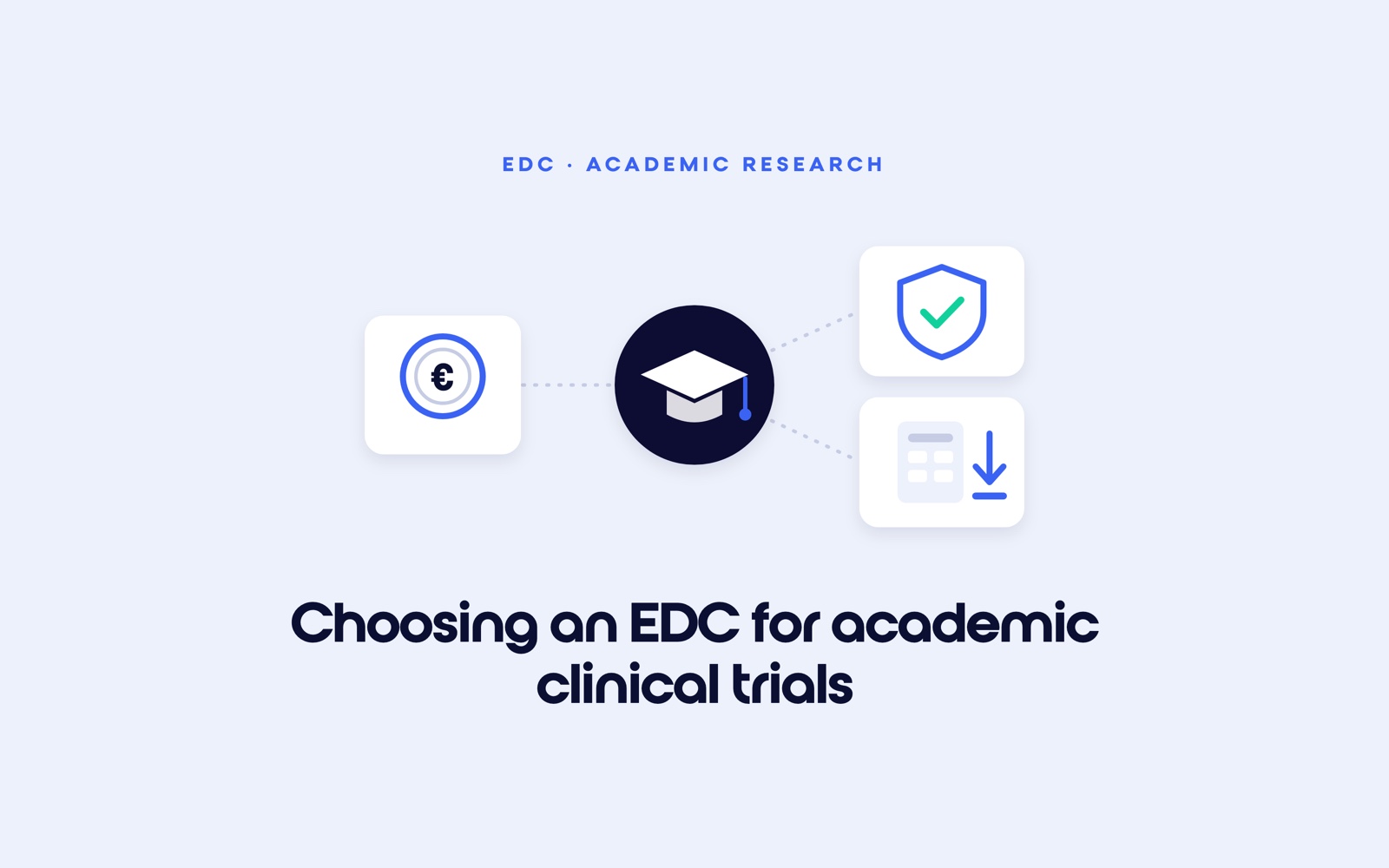
For an academic clinical trial, choose an EDC that your project manager can build without a data manager, that your institution does not have to host or validate alone, and whose total cost fits the grant you already have. Datacapt fits academic and hospital teams that want EDC, ePRO, eConsent and randomization on one patient record, a validation package included, and unlimited users across every site.
An academic trial buys its EDC under constraints that differ from an industry sponsor’s. The budget was fixed when the grant was awarded. One project manager often carries the eCRF, the sites and the regulatory file. And the institution acts as sponsor, with the obligations that come with the role, whether or not it has a quality department.
How do the main EDC options compare for academic research?
Four platforms come up most often in academic shortlists: Datacapt, Castor, OpenClinica and REDCap. They differ on who hosts and validates the system, who builds the study, and how the price is set. Datacapt comes first because this is our page, and the other three follow in alphabetical order. Each cell restates what the vendor or project publishes, as checked in September 2026.
| Criterion | Datacapt | Castor | OpenClinica | REDCap |
|---|---|---|---|---|
| Who hosts the system | The vendor, with EU data hosted in France on SecNumCloud-qualified infrastructure | The vendor, on certified servers in supported regions | The vendor, as a subscription platform | Your institution, on its own servers |
| Who validates the installation | A validation package comes included, and the sponsor validates its use | Castor describes its EDC as a validated system, and the sponsor validates its use | OpenClinica states that it delivers validated study builds, and the sponsor validates its use | Your institution, which builds the environment and its validation |
| Who builds the study | Your team in a visual builder, without programming | Your team in a no-code form builder, after Castor Academy courses, or Castor’s services | Your team with drag-and-drop tools, or OpenClinica’s team, which includes a study build | Your team, with support from your institution’s REDCap administrators |
| Modules published | EDC, ePRO, eConsent, randomization, medical coding, trial supply, Site CTMS | EDC, ePRO and eCOA, eConsent, randomization | EDC, eConsent, eCOA, randomization, EHR-to-EDC | Data capture and surveys |
| How the price is set | Per study or annual licence, unlimited users, no implementation fee | Tailored proposal, academic tier, site licence for institutions | Subscription, with pricing that the vendor states works with grant budgets | No licence cost for consortium member institutions, internal IT and quality time instead |
For a wider view, with thirteen platforms grouped by study type, see our comparison of 13 EDC platforms.
Which academic constraints change the choice of an EDC?
Four constraints separate an academic evaluation from an industry one: a budget fixed at grant award, a project manager who builds the eCRF without a data team, a statistician who decides what a usable export looks like, and an institution that carries the sponsor’s obligations. Test each platform against all four.
The grant fixed the budget before the protocol was final
Your funding covers a defined amount over a defined period, and most funders extend the period without adding money. Price the whole study, from build to archive, and add the costs that sit outside the licence: hosting, validation, IT time and support. A free tool with a server, an administrator and a validation file to maintain can cost your institution more than a licence that includes them.
No data manager builds the eCRF for you
In a hospital research unit without a data team, the project manager writes the case report form, configures it and trains the sites. Ask how long a person with your profile needs before building alone, and whether the vendor expects a certification first. Then ask who makes the change when an investigator requests a new field in month three.
The statistician decides what a usable export is
Your methodologist or biostatistician receives the data at the end, and every hour spent reshaping an export delays the analysis. During the evaluation, send a test export to that person and ask one question: can you run the statistical analysis plan on this file without rework? Studies with calculated scores and conditional visit paths make the test harder, and more useful.
Your institution is the sponsor
In an investigator-initiated trial, the hospital or university holds the sponsor role. Under ICH E6(R3), applicable in the EU since 23 July 2025, the sponsor remains responsible for computerized systems being fit for purpose and validated in proportion to risk, even when a vendor supplies them. Ask each vendor what documentation it hands over for that validation, and what your team still has to produce.
How should an academic team evaluate an EDC?
Run the evaluation on your own protocol and with the people who will use the system. Five steps give you evidence you can put in front of your sponsor committee, your methodologist and your IT department.
- Build one visit of your protocol. Pick a visit with a calculated score or a conditional path and ask for it during the demo. A form built in ten minutes in front of you says more than a finished study someone else designed.
- Send an export to your statistician. Ask for a test dataset from that visit and let the person who runs the analysis judge it.
- Ask for the validation file. List what the vendor provides and what your institution writes itself, as sponsor.
- Price the full duration. Include every site user, the months beyond the planned end date, and the internal time a self-hosted option would need.
- Call an academic reference. A hospital team running a study close to yours tells you more than an industry reference on a Phase III.
Our method article covers the sequence in more depth: how to choose an EDC for your clinical trial. For the validation side, see computerized system validation in clinical trials.
What does Datacapt bring to academic research teams?
Datacapt gives a hospital or university team a study its project manager builds without programming, EDC, ePRO, eConsent and randomization on one patient record, and a price that does not grow with the number of investigators and sites. The points below come from Datacapt’s product and pricing pages and from one published customer story. Our page for academic research teams presents the full offer for hospitals and universities.
- A visual builder where your team configures, tests and deploys the study, with a study build of 4 days and first patient in during week one on the Datacapt EDC product page.
- One patient record across EDC, ePRO, eConsent and randomization, so consent, questionnaires and clinical data never need reconciling.
- A validation package, support and training included, with unlimited users on every plan and no implementation fee, as the pricing page sets out.
- Exports in CSV, Excel and PDF for your statistician.
- Sovereign hosting: EU data hosted in France on SecNumCloud-qualified infrastructure, the French state qualification for cloud providers, issued by ANSSI. Among the thirteen platforms in our EDC comparison, Datacapt is the only one that publishes it.
At Strasbourg University Hospital, a clinical team ran a real-world sleep study with 24 questionnaires per patient sent on schedule by the platform. Users worked on their own after one to two hours of training, tasks that took days came down to one hour, and patients completed 85% of the questionnaires themselves.
An academic team chooses an EDC once and lives with it for the length of the study, often longer than planned. Test the platform on the part of your protocol that worries you most, and let your statistician judge the output. For an overview of what Datacapt offers hospitals and universities, see Datacapt for academic research teams.
What should an EDC offer for an investigator-initiated trial?
For an investigator-initiated trial, an EDC should let your project manager configure the study without programming, spare your institution from hosting or validating it alone, and fit the grant at full cost. Datacapt fits that case with EDC, ePRO, eConsent and randomization on one record, a validation package included and unlimited users.
Can a project manager build an academic study on Datacapt without a data manager?
Yes. Your project manager configures the study in a visual builder, without programming, and the Datacapt EDC product page states a study build of 4 days. At Strasbourg University Hospital, users worked on their own after one to two hours of training. Support and training come included in every plan.
How much does an EDC cost for an academic study?
An academic EDC costs the licence plus everything the licence leaves out: hosting, validation, IT administration, support and training over the full study duration. A free tool shifts those costs to your institution. Datacapt quotes per study or through an annual licence, with unlimited users, no implementation fee, and support, training and a validation package included.
Does an academic EDC need to be validated?
An academic EDC needs validation proportionate to risk. Under ICH E6(R3), applicable in the EU since 23 July 2025, the sponsor stays responsible for computerized systems being fit for purpose, and in an investigator-initiated trial the institution holds that role. Ask the vendor which validation documents it provides and which your team writes itself.
Can we move a running academic study to Datacapt?
You can, and the safest time is a study boundary: new studies start on Datacapt while running ones finish where they began. A mid-study move means exporting data and audit trail, mapping each field, rebuilding and testing, then reconciling records before sites switch. Datacapt’s pricing includes migration from another EDC, handled by its team.


With over 10 years of experience working in CROs, Khalil brings deep expertise in clinical trials and a clear understanding of the daily challenges faced by research professionals. His insights are grounded in real-world operations, making his perspective both practical and strategic.
Blog & News Datacapt
News, Articles, Resources et Tutorials.