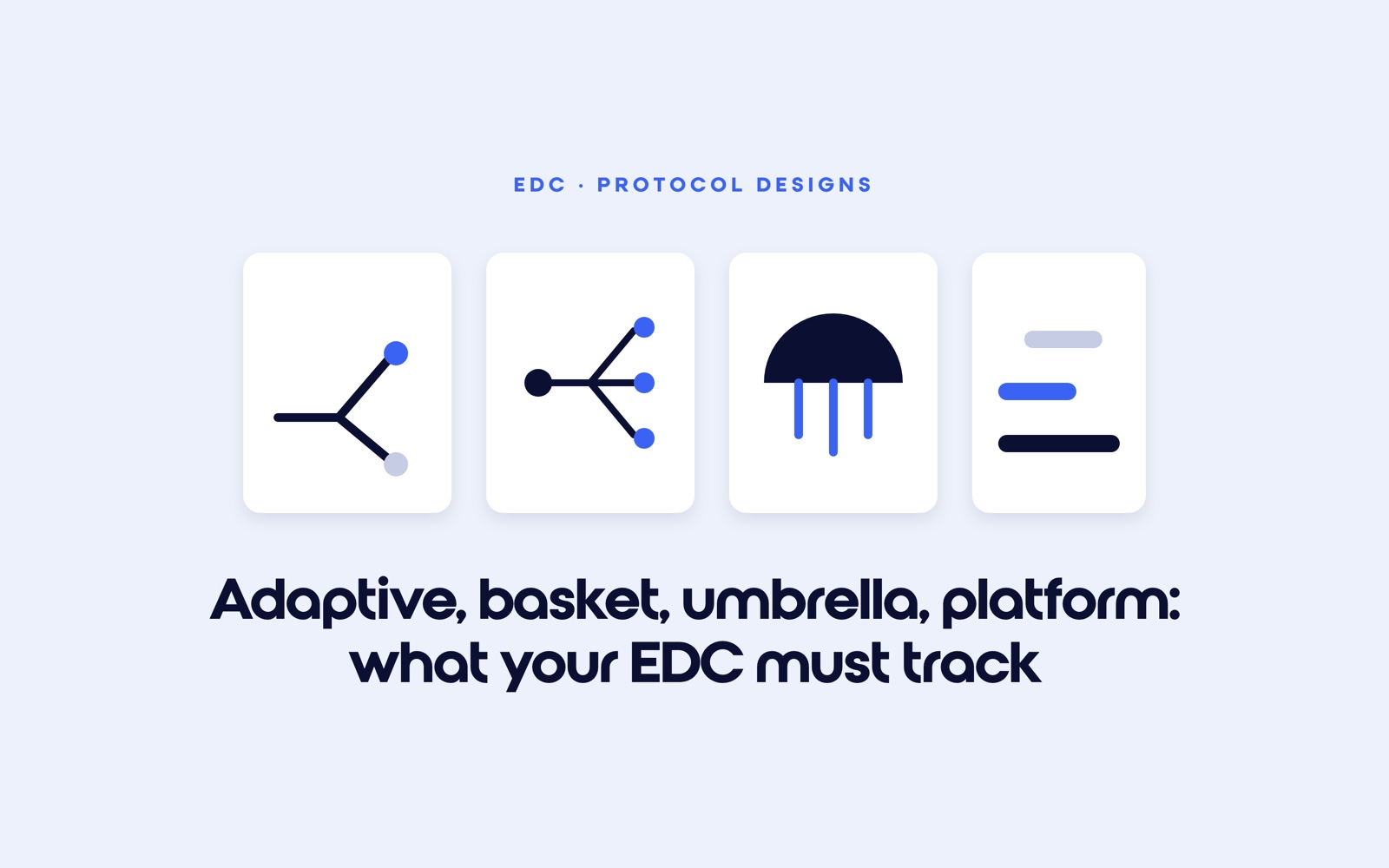
Adaptive, Basket, Umbrella and Platform Trials: What Your EDC Must Track
- A complex protocol design moves decisions into the study itself, so the EDC must record each planned change and keep data readable.
- Adaptive trials need a dated data cut, auditable ratio changes, arm closure that keeps treated patients' data, and role-based access to interim results.
- Basket trials need biomarker-driven eligibility and one export per cohort. Umbrella trials need screening data carried into each sub-study.
- Platform trials add arms by amendment, so the EDC must flag which control patients were randomized alongside each arm.
- ICH E20 on adaptive designs is still a draft: the EMA consultation closed on 30 November 2025 (EMA, 2025).
Your statistician has just sent the protocol. It includes an interim analysis that can drop an arm, or a master protocol with four sub-studies that open and close on their own calendar. The EDC your team used for the last two-arm trial was configured for a study that stays the same from first patient in to database lock. An adaptive trial design changes during the study by definition, and every planned change lands in the data system: new randomization ratios, closed cohorts, new arms, restricted access to interim results. For each of the four designs, here is what your EDC must handle before you sign the contract.
What does a complex protocol design change for your EDC?
A complex protocol design moves decisions that used to happen before the study into the study itself. Arms open or close, allocation ratios shift, cohorts stop for futility. The EDC must record each change, keep data from before and after it readable in one database, and restrict who sees results that could bias the trial.
Regulators have written this down. The FDA guidance "Adaptive Designs for Clinical Trials of Drugs and Biologics", final since November 2019, asks sponsors to prespecify the rules that govern each adaptation. For master protocols, the FDA finalized an oncology guidance in March 2022 and published a revised draft guidance, "Master Protocols for Drug and Biological Product Development", on 22 June 2026. In the EU, the European Commission, the EMA and the HMA published a joint Q&A on complex clinical trials in May 2022. The ICH is working on a harmonized text, ICH E20, which remains a draft: the EMA public consultation closed on 30 November 2025.
These texts share one expectation: the sponsor writes the rule before the data arrive, and the system shows that the team applied it.
The design is a separate question from the model you run the trial under, decentralized, hybrid or multicenter. A platform trial can be multicenter and hybrid at the same time.
Adaptive designs: what must your EDC handle at an interim analysis?
At an interim analysis, an adaptive trial applies a prespecified rule: drop an arm, change the allocation ratio, re-estimate the sample size or stop early. The EDC must freeze a clean data cut, apply the change without breaking the randomization list, and keep unblinded results away from the study team.
Check four points with your vendor:
- The data cut. Can you freeze a dated extract for the independent statistician while sites keep entering data?
- The ratio change. Can the team change the allocation ratio or the strata mid-study, with a record of who changed what and when?
- Arm closure. When an arm closes, does the system stop assigning patients to it while keeping the data of patients already treated?
- Blinding. Can you restrict interim results to the data monitoring committee, down to the role?
Write the data cut procedure into your data management plan before the first patient, with the name of the person who triggers it. The configuration itself starts like any randomized trial, and our guide on setting up randomization step by step covers the prerequisites.
I-SPY 2, a phase 2 platform trial in neoadjuvant breast cancer, uses adaptive randomization to assign more patients to the regimens that perform best in each biomarker signature. In July 2016, the New England Journal of Medicine published the first two regimens that met the trial's prespecified threshold for moving to phase 3. Every update of those probabilities depends on outcome data flowing back into the trial database on time.
Basket trials: one drug, several diseases
A basket trial tests one treatment in several diseases that share a molecular alteration. Each disease forms a cohort with its own size, its own response threshold and its own stopping rule. The EDC must handle eligibility driven by a biomarker, cohorts that progress at different speeds, and analyses run cohort by cohort.
The difficulty sits upstream, at screening. Patients enter on a test result, and one screening form can send them to one of six cohorts. Check that your eCRF can branch on that result, that each cohort can close without freezing the others, and that the export gives the statistician one clean dataset per cohort. A cohort that closes for futility after 12 patients sits in the same database as a cohort that goes on to 40. Our guide to exporting trial data for analysis lists the formats statisticians expect.
The FDA's revised draft of June 2026 on master protocols adds a section on basket trials and on evaluating one drug across several diseases. A draft guidance does not bind anyone, and it shows where reviewers will look.
Umbrella trials: one disease, several drugs
An umbrella trial enrolls patients with one disease, runs a shared screening, then assigns each patient to a sub-study according to a biomarker. Each sub-study can have its own drug, visit schedule and forms. The EDC must run several study designs under one protocol without duplicating patient records.
In practice, a patient with a given mutation goes to sub-study B, and the site sees the visit calendar and the forms of sub-study B only. Check three things. The screening data must follow the patient into the sub-study without a second entry. Each sub-study must keep its own schedule and its own edit checks. Your team must also be able to report on the whole protocol and on each sub-study, without two separate databases to reconcile at the end.
Platform trials: arms that enter and leave
A platform trial runs under a master protocol with no fixed end. New treatment arms join through protocol amendments, arms leave when they succeed or fail, and a shared control arm often serves several comparisons. The EDC must add an arm without rebuilding the study and keep the control data usable across comparisons.
The RECOVERY trial in the UK shows the scale. The trial started in March 2020 to test several COVID-19 treatments. By 16 June 2020, it had enrolled more than 11,500 patients from over 175 NHS hospitals, and the University of Oxford reported that dexamethasone reduced deaths by one third in ventilated patients: 2,104 patients received dexamethasone and were compared with 4,321 on usual care. The same usual-care group served as control for other arms of the trial.
For a platform trial, ask how the system handles eligibility when an arm opens halfway through, and how it marks which control patients were randomized at the same time as each experimental arm. The EU Q&A on complex clinical trials asks sponsors to justify the choice of control group when arms join at different times, because control data collected over a different period can affect how the trial is interpreted.
The checklist, design by design
| Design | What changes during the study | What to verify in the EDC |
|---|---|---|
| Adaptive | Allocation ratio, sample size, arm dropped at interim | Dated data cut, ratio change with audit record, role-based access to interim results |
| Basket | Cohorts open and close at different speeds | Biomarker-driven eligibility, per-cohort closure, one export per cohort |
| Umbrella | Patients assigned to sub-studies after shared screening | Screening data carried into the sub-study, schedule and edit checks per sub-study |
| Platform | Arms added by amendment, shared control arm | New arm without rebuild, eligibility per arm, concurrent control flagged |
Take this table into your next vendor demo and ask the vendor to show each line on a test study. A slide describing the feature does not prove that the team can run it.
[[cta]]
How Datacapt handles changing designs
Datacapt runs randomization inside the EDC, from the screen sites already use. Datacapt's randomization module supports block, stratified and dynamic randomization, including Pocock-Simon minimization. Your team can change allocation ratios or strata mid-study, with versioning and an audit record of each change.
Role-based masking protects the blind for sites and sponsors, and emergency unblinding is controlled by role, at site or sponsor level. Randomization and trial supply management share data in real time. Datacapt builds the eCRF on the CDISC ODM format and exports data on demand in CSV, Excel, PDF and SDTM, which gives the independent statistician a dated extract without a request to the vendor. Every entry, change and signature carries a user, a date and a reason in the audit trail.
Conclusion
Adaptive, basket, umbrella and platform designs ask the EDC to record decisions made during the study with the same rigor as those made before it. Before you choose, ask your biostatistician which adaptations the protocol allows and write them next to the matching line of the table. Then ask each vendor to run them on a test study, and keep the result in your vendor qualification file.
[[faq]]
Sources
- US Food and Drug Administration, Adaptive Designs for Clinical Trials of Drugs and Biologics, final guidance, November 2019
- US Food and Drug Administration, Master Protocols for Drug and Biological Product Development, revised draft guidance, June 2026
- European Commission, EMA and HMA, Complex clinical trials – Questions and answers, May 2022
- European Medicines Agency, ICH E20 Adaptive designs for clinical trials, draft guideline, consultation closed 30 November 2025
- New England Journal of Medicine, I-SPY 2 trial results, July 2016
- University of Oxford, press release on dexamethasone in the RECOVERY trial, 16 June 2020
What is the difference between a basket trial and an umbrella trial?
A basket trial tests one treatment in several diseases that share a biomarker, with one cohort per disease. An umbrella trial enrolls patients with one disease and assigns them to several treatments according to their biomarker profile. Both run under a master protocol, and both require eligibility rules driven by screening results in the EDC.
Can an EDC handle an adaptive trial design?
An EDC can support an adaptive trial design when it can freeze a dated data cut for the interim analysis, change allocation ratios with an audit record, close an arm without losing its data and restrict interim results by role. Ask the vendor to run these steps on a test study before you sign.
What is a platform trial?
A platform trial is a trial run under a master protocol with no fixed end date, where treatment arms enter and leave over time and often share a control arm. The RECOVERY trial in the UK, started in March 2020 to test COVID-19 treatments, is the best-known example.
Is ICH E20 on adaptive designs final?
ICH E20 "Adaptive Designs for Clinical Trials" reached draft status in June 2025, and the EMA public consultation closed on 30 November 2025. It is still a draft at the time of writing. For drugs and biologics in the US, the reference remains the FDA guidance on adaptive designs finalized in November 2019.


Florentin combines clinical research know-how with a true passion for product design. Attentive to detail and obsessed with user experience, he ensures that Datacapt remains a high-performance platform that’s also intuitive and accessible to every user.
Blog & News Datacapt
News, Articles, Resources et Tutorials.