- Tufts CSDD found 76% of 950 protocols amended at least once, 3.3 times on average, with 260 days to implement each amendment.
- The median direct cost of a substantial amendment was $141,000 in phase II and $535,000 in phase III (Tufts CSDD, 2016).
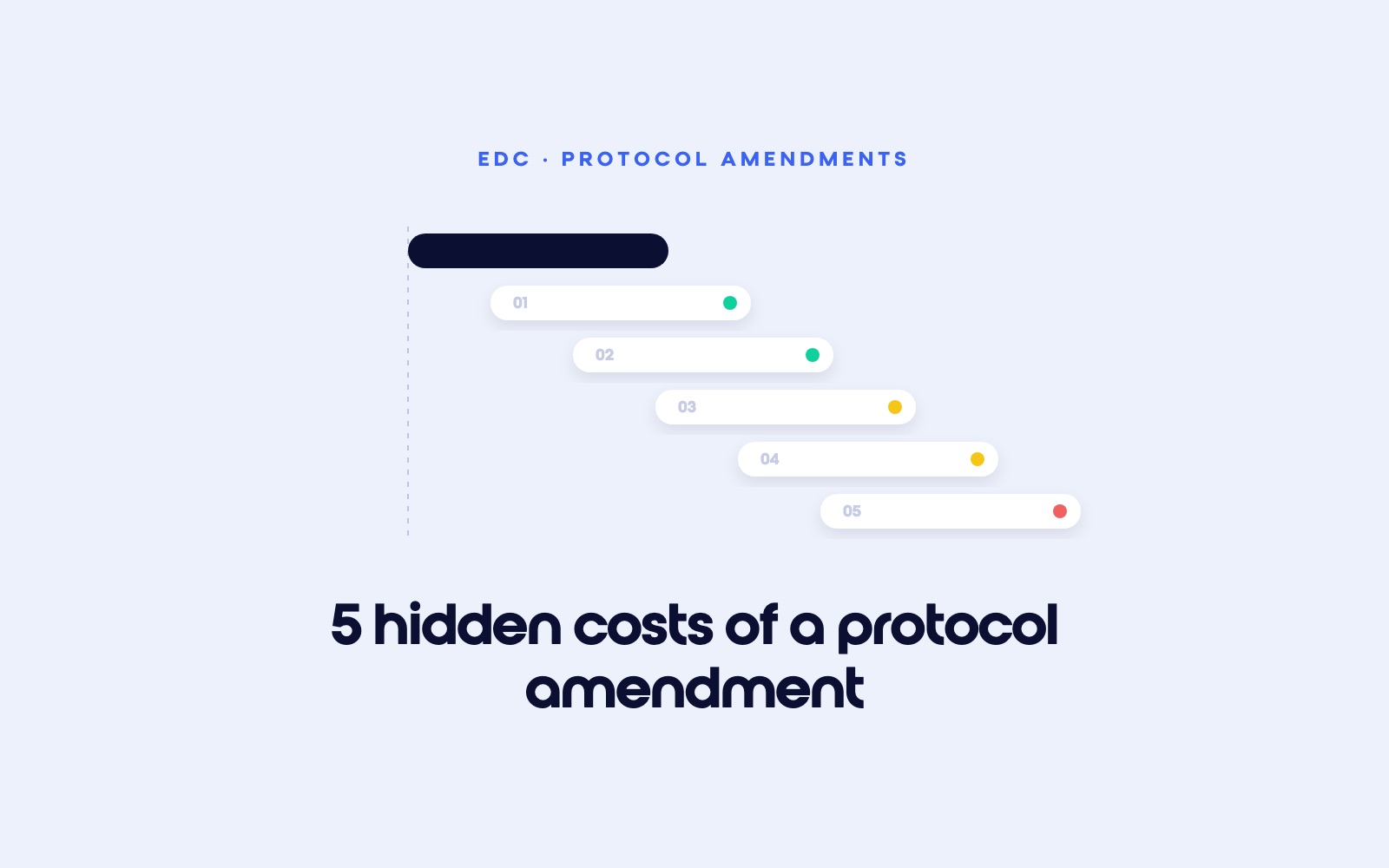
- Five costs sit outside the eCRF edit: site retraining, UAT, legacy queries, RTSM and supply changes, and re-consent.
- ICH E6(R3) asks investigators to assess re-consent and to get ethics approval of revised consent materials before use.
- Your EDC contract decides who edits forms, what happens to existing data and whether you can test before go-live.
A protocol amendment costs far more than the eCRF change your EDC vendor quotes. Tufts CSDD measured a median direct cost of $141,000 per substantial amendment in phase II and $535,000 in phase III, in a 2016 study of 52 protocols. Most of that money goes to five items that sit outside the form edit.
You will amend your protocol: a Tufts CSDD study of 950 protocols published in 2024 found that 76% go through at least one amendment, with 3.3 amendments per protocol on average, and that implementing one now takes 260 days from the decision to the last approval. Vendors sell "mid-study changes without downtime", and the downtime they remove is the smallest line on the bill.
1. Site retraining and version control
Every amendment sends each site back to training: new eligibility criteria, a new visit schedule, new forms. The same Tufts CSDD study measured that sites work with different protocol versions for 215 days on average, which means your CRAs monitor two sets of rules at once for seven months.
The hidden cost here is coordination time. Someone has to track which site has IRB or ethics approval for which version, which coordinator completed the training, and which patients follow which schedule. On a multi-site study, that tracking comes back at every amendment and lands on the study manager. Ask your team to budget it as a line item, with a named owner, before the amendment is submitted.
2. eCRF rebuild, edit checks and UAT
Changing a form means changing its edit checks, derivations and skip logic, then running user acceptance testing again before the new version goes live. A new inclusion criterion can touch the screening form, the eligibility checks and the randomization trigger at once, and each one needs a test script.
This is where vendor contracts diverge. Some EDC vendors bill amendments as change orders and schedule them in their own queue, others let your team edit and republish the form. Before you sign, ask who makes the change, how long the turnaround takes, and what a change order costs. The method for writing edit checks you can retest keeps the UAT effort predictable from one version to the next.
3. Queries on data collected under the old version
Data entered before the amendment still has to pass data review, and new edit checks can fire on records that were valid when the site entered them. A tightened lab range or a new mandatory field turns clean historical data into a wave of queries the sites did not expect.
Decide upfront, with your data manager, which checks apply to which version, and document it in the data management plan. Without that rule, your sites spend their time answering queries on visits that followed the protocol in force at the time, and your monitors spend theirs closing them. Ask your EDC vendor how records entered under version 1 stay readable and traceable once version 2 is live: the answer tells you how much reconciliation you will do by hand.
4. Randomization and supply parameters
An amendment that adds a stratification factor, drops an arm or changes the dosing schedule reaches your RTSM (randomization and trial supply management system). Allocations already made stay as they are, but the randomization configuration, kit types and supply forecasts have to change for every patient randomized after the amendment.
The cost shows up twice. First in the system change itself, which needs testing and a documented validation before any patient is randomized on the new rules. Then in the drug supply: depots and sites hold stock sized for the old design, and a supply plan tied to the RTSM has to absorb the difference without a stock-out at a site that is still recruiting.
5. Re-consent of enrolled participants
ICH E6(R3), applicable in the EU since July 23, 2025, asks investigators to assess whether new information requires re-consent of participants already enrolled, and requires ethics committee or IRB approval of revised consent materials before use (section 2.8.2). A safety update or a new procedure often triggers it.
Re-consent means a new consent version, translation into every study language, approval, then a visit or a remote session with each active participant. On paper, sites also have to file each signed form and prove the right version was signed. An eConsent module tracks which participant signed which version, and the eConsent implementation guide covers the approval steps.
How do you budget a protocol amendment before it happens?
Budget an amendment as a project with five line items: site retraining, form rebuild and UAT, legacy data review, RTSM and supply changes, and re-consent. Price each one from your last amendment, add the regulatory route, and check which items your EDC contract covers before the first amendment reaches the steering committee.
The regulatory route depends on where you run the study. In the EU, a substantial modification goes through CTIS and needs authorization under the Clinical Trials Regulation 536/2014 before you implement it. In the US, sponsors of drug trials submit protocol amendments to their IND under 21 CFR 312.30, with IRB approval before implementation. Under ICH E6(R3), changes to the protocol wait for ethics approval unless they remove an immediate hazard to participants.
Three contract questions decide how much of the bill lands on you:
- Who edits the forms: your team, or the vendor through a change order?
- What happens to existing data: does it stay readable and traceable under the version it was entered in?
- What UAT you can run: can you test the new version before patients see it?
These questions belong in the EDC selection checklist as much as price and features do.
[[cta]]
How Datacapt handles protocol amendments
In the Datacapt EDC, your study team pushes protocol amendments, form updates or logic revisions during the study, with no redeployment. No data is lost in the process: every record your sites entered before the amendment stays in the study. Each amendment becomes a new study version: version 1.0 closes, version 2.0 goes live, and your forms carry over with the data your sites entered under the previous version. Every entry, change and signature keeps its audit trail, with a user, a date and a reason.
Mid-study form changes stay in your team's hands, with no vendor ticket. Re-consent runs on the same platform: the eConsent module tracks the consent version signed by each participant and supports re-consent workflows. Because eConsent, randomization and trial supply sit next to the eCRF, your team handles the whole amendment, from the form change to the re-consent, with one vendor and one database.
An amendment will reach your study sooner or later. Your EDC decides one line of its budget, and your preparation decides the other four: a named owner for site version control, a rule for legacy data, a tested supply plan and a re-consent process you have run before. The teams that price those items before the first amendment are the ones that keep their timeline when it lands.
Frequently asked questions
[[faq]]
How much does a protocol amendment cost?
A 2016 Tufts CSDD study of 52 protocols measured a median direct cost of $141,000 to implement a substantial amendment in a phase II trial and $535,000 in phase III. The figure covers direct implementation costs, and it excludes the delay: implementing an amendment took 260 days on average in the 2024 Tufts CSDD follow-up.
How many clinical trials go through a protocol amendment?
A Tufts CSDD study published in 2024, based on 950 protocols from 16 companies, found that 76% of phase I to IV protocols had at least one amendment, against 57% in 2015. The average protocol went through 3.3 amendments, and 77% of amendments were judged unavoidable.
Does a protocol amendment require re-consent?
Not always. ICH E6(R3), section 2.8.2, asks investigators to assess whether new information could affect a participant's willingness to continue. If re-consent is needed, for example after a new safety finding, the revised consent materials need ethics committee or IRB approval before use.
Can you change an eCRF during a clinical trial?
Yes. Mid-study eCRF changes follow an approved protocol amendment and go through edit check updates and user acceptance testing before release. Check with your EDC vendor who makes the change, how long it takes, and how data entered under the previous version stays readable and traceable.
What is the difference between a substantial and a non-substantial amendment?
In the EU, a substantial modification is a change likely to affect participant safety or rights, or the reliability of the data, and it needs authorization through CTIS before implementation. Non-substantial changes, such as administrative updates, are documented without prior authorization. US rules follow their own categories under 21 CFR 312.30.


With over 10 years of experience working in CROs, Khalil brings deep expertise in clinical trials and a clear understanding of the daily challenges faced by research professionals. His insights are grounded in real-world operations, making his perspective both practical and strategic.
Blog & News Datacapt
News, Articles, Resources et Tutorials.