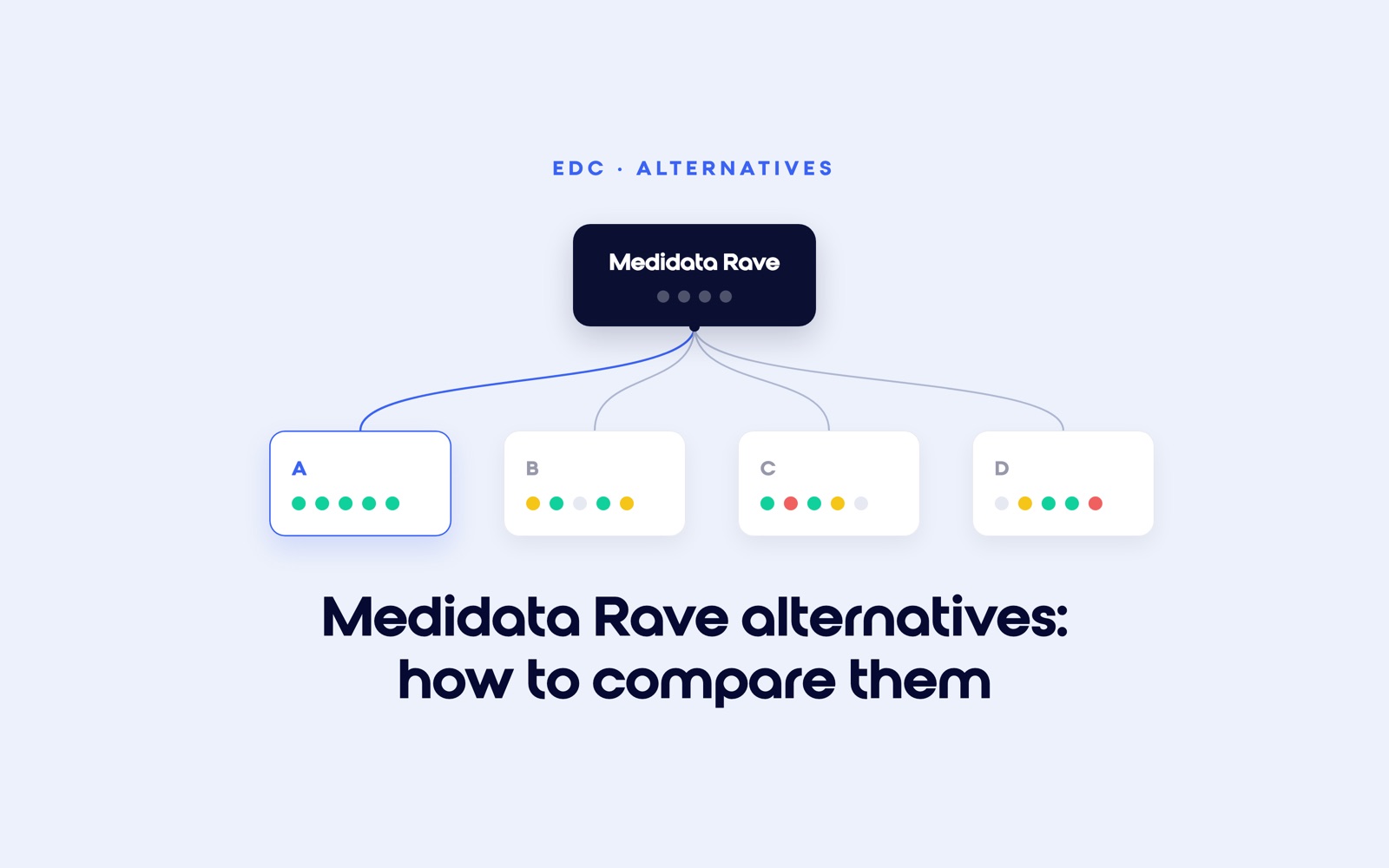
- Compare Medidata Rave alternatives on who builds the study, which modules share one patient record, and what the price covers.
- Tufts CSDD found that 76% of protocols are amended at least once, so test each platform on a real amendment (Tufts CSDD, 2024).
- Datacapt keeps EDC, ePRO, eConsent, randomization, medical coding and trial supply on one record, with unlimited users on every plan.
- The EMA expects sponsors to validate a data migration with no less focus than the new system itself (EMA, 2023).
- Switch platforms at a study boundary when you can: running studies finish where they began, and new studies start on the new platform.
The right alternative to Medidata Rave depends on the size of your study and on who you want to build it. Datacapt fits CROs, small pharma, medical device teams and academic institutes that want EDC, ePRO, eConsent, randomization and trial supply on one patient record, a study their own team builds in days, and unlimited users on every plan.
You are reading this because Medidata Rave is the EDC your sponsor, your CRO or your last employer used, and your next study does not look like their programs. The choice shows on the first amendment: a Tufts CSDD study published in 2024 found that 76% of protocols are amended at least once, and that sites work under different protocol versions for 215 days on average. This page compares four alternatives on study build, modules and target studies, sets Datacapt and Rave side by side, and lays out how to move a study without losing its audit trail.
Why do teams look for an alternative to Medidata Rave?
Teams look beyond Medidata Rave when their next study is a single Phase I, a device investigation or an investigator-initiated study, and the contract feels sized for a larger program. They want a study their own team builds and changes, a price set on their protocol, and the modules they need without a second contract for each.
Medidata builds Rave EDC as the center of a wider platform, where eConsent, eCOA, RTSM, Coder+, Imaging, CTMS and eTMF are separate products. Study build runs in Medidata Designer, by your team or by Medidata's Study Configuration Services. Medidata publishes no price and routes pricing questions to a specialist. For Phase I, Phase IV and medical device post-market studies, it sells Rave Lite, which it describes as a cost-effective and focused version of Rave with pre-configured libraries and a flexible pricing model.
If Medidata Rave Lite covers your study, it keeps you on a system your sites may already know. If your study also needs ePRO, randomization or trial supply, ask which Medidata contracts each module adds.
How do the main Medidata Rave alternatives compare?
This page sets four platforms side by side for teams below enterprise scale: Datacapt, Castor, Medrio and OpenClinica. They differ on who builds the study, which modules sit on the same platform, and which studies they are built for. Each cell restates what the vendor publishes on its own website, checked on 6 November 2026.
| Platform | Who builds the study | Modules published | Built for |
|---|---|---|---|
| Datacapt | Your clinical team in a visual builder, without programming, with Datacapt AI drafting forms from your schedule of assessments | EDC, ePRO, eConsent, randomization, medical coding, trial supply, Site CTMS | CROs, pharma and biotech, medical device teams and academic institutes, from Phase I to IV |
| Castor | Your team in a no-code builder, or Castor's study build services. Castor states that low-complexity studies launch in 3 to 4 weeks. | EDC and CDMS, eCOA and ePRO, eConsent, medical coding, AI data extraction from source documents | Sponsors, CROs, medical device manufacturers and academic centers |
| Medrio | Your team with no-code tools, or Medrio's service team for database build and data management | EDC and CDMS, ePRO and eCOA, eConsent, RTSM | Small and scaling clinical teams, from early phase to post-market |
| OpenClinica | Your team with drag-and-drop tools and templated CRFs, or OpenClinica's experts, who offer the study build at no charge | EDC, randomization with inventory management, EHR-to-EDC, eConsent, eCOA | Academic research organizations, investigator-initiated studies and lean teams |
For the full market view, with thirteen platforms grouped by study type, see our comparison of 13 EDC platforms. If Castor is also on your shortlist, our page on Castor EDC alternatives sets it against other EDC platforms.
How does Datacapt compare with Medidata Rave?
Datacapt and Medidata Rave both capture, clean and report trial data, and both deploy protocol amendments during the study without downtime. They differ on who builds the study, how many contracts your modules take, and how the price is set. Each cell restates what the two vendors publish, checked on 6 November 2026.
| Criterion | Datacapt | Medidata Rave |
|---|---|---|
| Who builds the study | Your clinical team in a visual builder, without programming | Your team in Medidata Designer, or Medidata's Study Configuration Services |
| Time to go live | Study build of 4 days, first patient in during week one, 1 to 4 weeks per new study | No average build time on the Rave EDC page; Rave Lite promises reduced study build times |
| Modules | EDC, ePRO, eConsent, randomization, medical coding, trial supply and Site CTMS on one patient record | Rave EDC at the center of the Medidata Platform, with eConsent, eCOA, RTSM, Coder+ and CTMS sold as separate products |
| Smaller studies | The same full platform from Phase I to IV, with no feature tiers | Rave Lite, a focused version for Phase I, Phase IV and device post-market studies |
| Price | Written quote per study or annual licence, unlimited users, no implementation fee, reduced rate for academic and non-profit teams | Not published; quoted by a Medidata specialist. Rave Lite has a flexible pricing model. |
| AI in study build | Datacapt AI drafts sections, fields and UAT scripts from your protocol content. You can connect your own model over an MCP server, under your own permissions and audit trail. | Designer translates study plans into eCRFs and generates test cases, with a person in the loop |
The modules row carries the largest difference for a small team. On Datacapt, trial supply, randomization and site scheduling sit on the record that holds the clinical data, under one contract and one validation package.
What does Datacapt bring as an alternative to Medidata Rave?
Datacapt gives your team a study it builds and amends itself, every module on one patient record, and a price that does not grow with the number of users. The figures below come from Datacapt's product, pricing and security pages.
- Study build in 4 days, first patient in during week one, as the Datacapt EDC product page states, and 1 to 4 weeks to go live per new study.
- One patient record across EDC, ePRO, eConsent, randomization, medical coding and trial supply, with the Site CTMS on the same platform.
- Amendments without redeployment: your team pushes form updates and logic revisions during the study, with no data loss and no vendor ticket.
- Datacapt AI drafts the study from the content of your protocol and drafts UAT scripts against it. Nothing reaches the study without a person, and every call lands in the audit trail.
- One price per study or one annual licence, with unlimited users, no implementation fee, the validation package included and a reduced rate for academic and non-profit teams, as the pricing page sets out.
- A choice of hosting: 3DS Outscale, a French cloud qualified SecNumCloud by ANSSI and certified HDS, or AWS regions, as the security page sets out.
At CHRU Strasbourg, a hospital team ran a real-world study with 24 questionnaires per patient. Users were autonomous after 1 to 2 hours of training, and the team configured and tested every questionnaire and workflow itself within days.
[[cta]]
What should you compare when you look beyond Medidata Rave?
Compare the platforms on your next study. Four questions separate the options: whether the lighter offer of your current vendor covers the study, who builds and amends it, what happens to collected data when the protocol changes, and what the price covers over the real duration of the study.
Does Medidata Rave Lite cover your study?
Start with the option your current vendor already sells. Medidata positions Rave Lite on Phase I, Phase IV and device post-market studies. Ask which modules come with it, which ones need a separate Medidata product, and what changes in price and build if the study grows into a larger phase.
Who builds the study, and who amends it
Ask how long your coordinator needs before building alone, and who makes the change when a site asks for a new field in week six. If a vendor service builds the study, ask who makes each amendment and how many days the request takes.
What happens to collected data when the protocol changes
Tufts CSDD measured in 2024 an average of 3.3 amendments per protocol. Ask each vendor to replay one of your past amendments: who edits the form, how it reaches the sites, and whether records entered under the previous version stay in one dataset.
What the price covers
Ask which unit drives the price: study, module, user or site. Then ask for the price of your real study over its real duration, with every user your sponsor and sites will add, and check whether implementation and validation come on top.
How do you move a study off Medidata Rave?
Move at a study boundary when you can: start the next study on the new platform and let running studies finish on Medidata Rave. Each dataset stays in one system and you avoid a mid-study migration. When a running study has to move, the EMA guideline on computerised systems of 2023 sets out what the migration must prove. The Datacapt team handles migrations from another EDC.
The table follows section 6.10 of the guideline, step by step.
| Step | What you do | What the EMA guideline expects |
|---|---|---|
| 1. Plan | List the data, metadata, audit trail and study definition to move, and the risks of each | A detailed plan and a risk analysis before the migration |
| 2. Map | Map each form, field and code list from Medidata Rave to the new structure, with your data manager | The mapping from the old system to the new one is retained |
| 3. Rehearse | Run the full migration on mock data and fix what breaks | The procedure is validated with mock data first |
| 4. Migrate and verify | Move the data, then compare record counts, checksums and key values between the two systems | Verification focused on key data after the migration |
| 5. Keep the audit trail | Check that every value still carries its history in the new system | Data, contextual information and audit trail are not separated |
| 6. Switch sites | Retrain sites on the new screens, then retire Medidata Rave under your retention rules | Data stays available to authorized people for the whole retention period |
The guideline asks for a validation of the migration process with no less focus than the validation of the system itself. Budget the time for it in your plan. Our article on computerized system validation covers the system side, and our method article explains how to choose an EDC for your clinical trial.
When is Datacapt not the right choice?
Datacapt suits teams that want to build their studies in-house and keep every module on one record. Four situations call for a different platform.
- Your sponsor mandates Medidata Rave. Large sponsors standardize on one EDC across their programs, and the CRO runs the study where the sponsor decides.
- You standardize a large pharma portfolio on one vendor. Datacapt has a smaller global footprint than long-established enterprise vendors.
- You need a portfolio-level CTMS. Datacapt includes a Site CTMS for site operations. Contract, budget and resource management across a portfolio call for a dedicated CTMS.
- Your endpoints rely on central imaging or adjudication. Medidata sells imaging management and endpoint adjudication on its own platform, which Datacapt does not publish.
The test of an alternative comes on your second study more than on your first. Ask each shortlisted vendor to build a section of the next study you plan, with the amendment you expect and the kits you will dispense, then decide from those builds whether to switch now, at the next study, or not at all.
[[faq]]
Sources
- Getz K., Smith Z., Botto E., Murphy E., Dauchy A., Tufts Center for the Study of Drug Development, New Benchmarks on Protocol Amendment Practices, Trends and their Impact on Clinical Trial Performance, Therapeutic Innovation & Regulatory Science, 2024.
- European Medicines Agency (EMA), GCP Inspectors Working Group, Guideline on computerised systems and electronic data in clinical trials (EMA/INS/GCP/112288/2023), 2023.
What are the best alternatives to Medidata Rave?
The best alternative depends on your study. Datacapt fits CROs, small pharma, medical device teams and academic institutes that want EDC, ePRO, eConsent, randomization and trial supply on one patient record, a study built in 4 days and unlimited users on every plan. Castor, Medrio and OpenClinica cover other study profiles, compared in the table on this page.
What is Medidata Rave Lite?
Rave Lite is a version of Rave EDC that Medidata sells for Phase I, Phase IV and medical device post-market studies. Medidata describes it as cost-effective and focused, with pre-configured libraries of forms and edit checks, faster study builds and a flexible pricing model. It covers data capture and data management; other Medidata modules remain separate products.
How is Datacapt different from Medidata Rave?
Datacapt runs EDC, ePRO, eConsent, randomization, medical coding, trial supply and a Site CTMS on one patient record, under one price per study or one annual licence with unlimited users. Your clinical team builds the study in 4 days without programming, and Datacapt AI drafts forms and UAT scripts. EU data can stay in France on SecNumCloud-qualified infrastructure.
How much does Medidata Rave cost?
Medidata publishes no price for Rave and routes pricing questions to a specialist. For Rave Lite, it states a flexible pricing model. Datacapt publishes how its price is set: a written quote on enrolled patients, visits, sites, duration and modules, per study or as an annual licence, with unlimited users and no implementation fee.
Can you migrate a running study from Medidata Rave to another EDC?
You can, and the EMA guideline on computerised systems of 2023 sets the bar: a detailed plan and risk analysis, a rehearsal on mock data, verification of key data after the move, and an audit trail that stays attached to the data. Moving at a study boundary avoids most of that work. The Datacapt team handles migrations from another EDC.


With over 10 years of experience working in CROs, Khalil brings deep expertise in clinical trials and a clear understanding of the daily challenges faced by research professionals. His insights are grounded in real-world operations, making his perspective both practical and strategic.
Blog & News Datacapt
News, Articles, Resources et Tutorials.